Showing posts with label Movies 1. Show all posts

Thursday, 27 August 2020

Bill & Ted Face the Music

The very good cinematic news in a week when everyone could use a smile is that “Bill & Ted Face the Music” is essentially all it needed to be. It’s a long-awaited sequel that doesn’t betray its beloved characters, and it doesn’t merely repeat what people loved about them in the first place. Most of all, it is a remarkably likable comedy about two good guys still trying to find their place in the world that’s anchored by genuinely sweet beliefs about the importance of friendship, honesty, and, most of all, music. Be excellent to each other, dudes. It still matters.

Long past the point where they merely need to pass their history class, Bill (Alex Winter) and Ted (Keanu Reeves) are now parents to daughters named Thea (Samara Weaving) and Billie (Brigette Lundy-Paine). They’re still married to the princesses from the first film, played here by Erinn Hayes and Jayma Mays, but the relationships have gotten a bit rocky. Part of the reason is that when Bill & Ted are told they need to go to couples therapy, they think both couples need to be there at the same time—Bill does nothing without Ted, and vice versa. They can't even say "I" when they're in therapy, resorting to "We." Whatever one feels, so does the other one. 

The problem is that their band Wyld Stallyns has yet to write the song that will bring the universe together. After years of fame that dissipated to such a degree that they have now been reduced to playing open mics, they’re still trying to write just the right tune, and failing over and over again. In a sense, “Face the Music” is about feeling like you didn’t live up to your destiny, like you failed a younger version of yourself who was set on changing the world.

It turns out that Bill & Ted have run out of time to do what they were told they had to do by Rufus—George Carlin is lovingly tributed here and then recast in a sense in the form of Rufus’ daughter Kelly, played by Kristen Schaal. After therapy, Bill & Ted are sped off to another reality by Kelly, where they meet The Great Leader (Holland Taylor), who tells them they have to write the song that ties all of the universe together or humanity will literally cease to exist. It’s already starting to happen as figures from the past are being zapped into the present day, ripping apart the fabric of time. “Tenet” isn’t the only time travel movie this week.

And so Bill & Ted decide to go to the future to steal the song from themselves, leading to some wonderful, funny sequences in which the guys meet versions of themselves in their possible futures. In most of them, they’re angry and alone, and Bill & Ted realize that they’re going to lose the princesses if they don’t fix their home lives too. Meanwhile, their daughters get the classic B&T roles of journeying back through time to meet important figures from history. They try to put together the dream band to back their dads to save the day, including Mozart, Jimi Hendrix, Louis Armstrong, and Kid Cudi, wonderfully playing himself. Eventually, Bill & Ted cross paths with Death (William Sadler) again and even encounter a hesitant killer robot named Dennis Caleb McCoy, played hysterically by Anthony Carrigan of “Barry” fame.

“Bill & Ted Face the Music” is fast-paced and funny. Winter falls into his old shoes a little better than Reeves, but Keanu’s genuine likability as an actor goes a long way with some of his best lines. There’s a refreshing lack of cynicism in these movies that honestly believe that friendship and creativity are going to tie us all together through history, something that feels like it registers with Winter and Reeves in their real lives too. These are compassionate actors and that comes through in the roles. This is not the kind of late sequel that's a cash grab. It's clearly a labor of love.

The “troubled marriages” subplot gets a bit too much screen time and doesn’t work as well as the best material in the film (and some early scenes feel a little clunky in terms of pacing), but it’s never anything that lasts too long. By the time Bill, Ted, their equally charming daughters, Death, an unforgettable robot, and Kid Cudi are in the final stages of trying to save the world, it’s a movie that almost dares you not to like it. It’s goofy in all the right ways and even serves as a reminder that it’s never too late to face the music, but only if we do it together.


Friday, 7 August 2020

The Grizzlies

It isn't unusual for me to check a film's end credits to find the name of an actor whose performance strikes me as exceptional. I also enjoy tracking my favorite actors across different roles. But it is unusual for me to search for a name in three different films, playing characters with three different nationalities, in three different time periods, without realizing it was the same actor. Ben Schnetzer disappeared so convincingly into his roles as a gay British activist in "Pride," a Jew hiding from the Nazis in "The Book Thief," and an outspoken techie in "Snowden" that I did not recognize him. Most actors are very good at conveying complex emotions, but few are as specific in their choices of posture, voice, gesture, and expression to disappear into a role.  

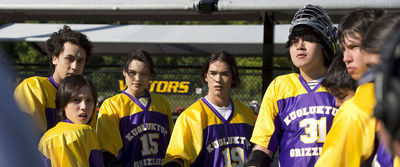
In "The Grizzlies," based on a true story, Schnetzer takes on yet another nationality to play Russ, a Canadian teacher in one of the most remote places in the world, Kugluktuk, Nunavut. Sent there with just two days' notice to put in the required community service hours while he waits for a job at a posh prep school, he knows almost nothing about the region or its people, part of an indigenous tribe near-ruined by modern "conveniences" that separate it from its traditions. Schnetzer's performance here is not as showy as some of his others, but his subtlety is well matched to the understated authenticity of the indigenous actors who play the students and members of the community. Standouts in those roles include Booboo Stewart, Anna Lambe, and Emerald MacDonald as students, whose dignity and authority keep Russ from becoming the kind of White Savior that has been the theme of too many films, especially films about young people of color.  

The opening scene shows us what appears at first to be a boy and a dog taking an idyllic walk through pristine, snowy vistas. But it quickly turns tragic and we learn that this area has the highest teen suicide rate in North America, as well as widespread domestic abuse and alcoholism.  

The principal has seen too many of these eager young teachers from "the South" to allow Russ to waste her time by telling her how glad he is to be there, and how much he hopes to accomplish. He gets a sense of how little he knows about the community when he asks a local (played by real-life Member of Parliament Jack Anawak) how long he has lived in Nunavut, and the man answers, "6,000 years." He tries to ingratiate himself with the class by telling them to call him Russ "because Mr. Sheppard is my father," and they tell him the reason they won't call him "Mr. Sheppard" is that "Mr." is a white man's term. There is nothing the school can teach them that will help them in their community's primary activities—hunting, fishing, and getting wasted. 

Russ has a lot to learn from these students, as he begins to realize when he carelessly dismisses a boy's heartbreak over his girlfriend, not realizing that the boy is suicidal. But Russ also has something to teach them, or allow them to reclaim. He is a lacrosse player, and is so attached to his lacrosse stick that he carries it while he goes for a run. Lacrosse, as he reminds them, is a game invented by First Peoples, and can give them what they have never felt or even seen: hope, pride, and a sense of achievement.

Yes, I know, there are countless "inspired by a true story" movies about teachers who give students a sense of purpose through sports or music or debate or math or whatever. But that is because stories about inspiration, especially true stories, are spirit-lifting, heartwarming, and even thrilling if they are told with specificity and skill. "The Grizzlies," with a solid screenplay from television veterans Moira Walley-Beckett ("Breaking Bad") and Graham Yost ("Justified") wisely avoids making interactions with the locals a way for Russ to become more mature or fall in love. Miranda de Pencier, an experienced producer directing her first feature, is a Canadian with a deep appreciation for the landscapes and a sincere respect for its original residents. She shows us that such bleakness is the result of pain and loss of a sense of identity. Though it's a familiar plot about kids learning discipline and teamwork through sports, "The Grizzlies" is brought to life through the specifics that make the characters and their sense of place—and of displacement—central to the story.


Saturday, 1 August 2020

The Secret: Dare to Dream

We could all use a little hope these days. More than a little, actually. But you won’t derive much inspiration from “The Secret: Dare to Dream” besides some unintentional laughter to briefly brighten your day.

Based on the 2006 self-help book from Rhonda Byrne, which has sold tens of millions of copies with the help of Oprah Winfrey’s blessing, this romantic drama is filled with vapid platitudes about the power of positive thinking. Director and co-writer Andy Tennant’s film takes place in a generically quaint small town full of blandly nice people who are woefully devoid of characterization, even though they’re frequently stuck standing around explaining themselves to each other. Even something as potentially thrilling as an approaching hurricane can’t liven things up.

There is nothing new, exciting or particularly challenging about what “The Secret: Dare to Dream” is selling. You’d be forgiven for thinking you’d seen this movie before, as it hews so closely to the kind of comforting fare airing 24/7 on the Hallmark Channel. It’s also Nicholas Sparks-adjacent, with Madisonville, Louisiana, on the banks of Lake Pontchartrain standing in for North Carolina. This is the kind of place where the sun always sets just perfectly, the misty rays of light streaking through the dangling moss, and characters with names like Tuck and Bray wear puffy vests and button-down shirts with elbow patches.

Within this seemingly idyllic setting, Katie Holmes’ Miranda Wells is buried under massive stress and debt. A widowed single mom of three kids managing a New Orleans seafood restaurant, she’s too broke to afford simple pleasures like pizza, so fixing the leaky roof is clearly out of the question. She’s also half-heartedly dating her boss, the blithely wealthy Tuck Middendorf (Jerry O’Connell), which is more of a source of pressure than joy.

Magically, Josh Lucas’ Bray Johnson arrives, carrying a manila envelope with a red wax seal which must mean that it’s very important. (It also happens to be the logo of “The Secret.”) The handsome professor has traveled from Nashville to bring some life-changing information to Miranda, but ends up getting distracted when they meet cute during a fender bender. Not only does he cheerily repair her front bumper, he also patches up the roof on her house when the hurricane sends a tree crashing through her kitchen.

Too good to be true? But wait, there’s more! Along the way, the irrepressibly upbeat Bray insinuates himself with the entire family by offering pithy tidbits of wisdom to each of them. He begins by explaining the law of attraction with a magnet and a paper clip: “The more you think about something, the more you draw it to you,” he insists. So when Miranda’s tween son Greg (Aidan Pierce Brennan) rhapsodizes over the aforementioned pizza, a delivery man arrives with the exact kind he wanted. When sullen eldest child Missy (Sarah Hoffmeister) laments that no one’s coming to her 16th birthday, Bray easily convinces her that having only a few real friends matters. And when Bessie (Chloe Lee), the youngest, longs for a pony … well, you can imagine what happens.

“My whole life is like that gut feeling that something really bad is going to happen. And then … it does,” Miranda confides in him. “You know, things don’t have to be a series of unfortunate events,” Bray responds before popping over to the lumber yard to pick up some 2-by-4s and a blower to dry the floors – which naturally will be right there waiting for him because he needs them, despite the fact that a hurricane has just blown through town.

This overly simplistic philosophy might seem borderline dangerous in these difficult times if it weren’t presented in such silly, predictable fashion. (Rom-com veteran Tennant co-wrote the script with Rick Parks and Bekah Brunstetter.) Got Covid? Just wish it away. Lost your job because of the pandemic like tens of millions of other Americans? If you want your dream gig badly enough, it’ll magically happen. Can’t pay the rent? Money will show up in your bank account if you put it on your vision board. In a place where birds chirp pleasantly and tinkly piano music accompanies the most banal of errands, anything is possible.

But wait, there has to be conflict somewhere, and it arrives in melodramatic form in the third act. This is one of those movies where everything would be resolved quickly if the two main characters had a basic conversation at the outset; because they don’t, Bray’s true identity and purpose emerge in front of a crowd during a happy occasion, as they are wont to do.

Holmes and Lucas give earnest performances and do the best they can with such flimsy material, but they have zero chemistry with each other. There’s just so little to these characters for them to work with. But at one point, I said out loud to myself in an empty room: “Oh my god, are they really going to kiss in a Waffle House parking lot?” And for one glorious, shining moment, I manifested my own happiness.


Monday, 27 July 2020

John Saxon: 1935-2020

They killed John Saxon again? 

That was my first thought upon learning that Saxon (birth name: Carmine Orrico) died from pneumonia over the weekend in his Murfreesboro, Tennessee home. You might remember Saxon, a Stella Adler-trained character actor, from “Enter the Dragon.” Saxon plays Roper, a cocky American gambler and martial artist, opposite Bruce Lee and Jim Kelly. Or maybe you know John Saxon as Donald Thompson in “A Nightmare on Elm Street,” one of a handful of moody cops that Saxon played over the course of his 50+ year-long film career. Saxon’s character was part of the suburban posse that originally killed Freddy Krueger. Robert Englund’s undead villain returned the favor in “A Nightmare on Elm Street 3: Dream Warriors,” but Saxon came back anyway in “Wes Craven’s New Nightmare,” playing himself. 

Saxon was a fixture of beloved genre films and TV shows, some more memorable than others: he’s Anthony Franciosa’s murderous literary agent in “Tenebre”; the frustrated cop who tries to protect Margot Kidder from a deranged killer in “Black Christmas”; the dependable physician/love interest who stands by Letícia Román in “The Girl Who Knew Too Much”; and so much more. Saxon had a bounce in his step, chest hair to match his caterpillar eyebrows, and a mischievous quirk in his smile that made him stand out in an estimated 200+ roles. In real life, he knew judo and tai chi. He also had great teeth. No, seriously: John Saxon’s gone.

Saxon was born in Brooklyn on August 5th, 1935, the son of the Calabria-born Antonio and Anna Orrico. He caught an early break as a male model (“Modern Romance, all the Macfadden publications”), and, at the age of 17, was discovered by Hollywood agent Henry Willson, who also helped to launch the careers of Rock Hudson and Tab Hunter. Willson noticed Saxon on the cover of a detective magazine, where Saxon posed as “a Puerto Rican guy” who gets shot and falls over a garbage can while his girlfriend looks on, aghast. 

Saxon would go on to play a few more ethnically ambiguous tough guys, like in “The Appaloosa,” a 1966 western where Saxon, as Mexican horse thief Chuy Medina, defeats Marlon Brando in a high-stakes arm-wrestling contest involving poisonous scorpions and glistening brows. Saxon was nominated for a Golden Globe for “Best Supporting Actor” that year; he had previously won the “Best New Star of the Year” award in 1958. Other recipients of that award include: Paul Newman (1957, for “The Silver Chalice”); James Garner (1958, “Sayonara”); Brad Dourif (1976, “One Flew Over the Cuckoo’s Nest”); Arnold Schwarzenegger (1977, “Stay Hungry”); James Earl Jones (1971, “The Great White Hope”); and Ben Kingsley (1983, “Gandhi”). 

Then again, Saxon’s career was not the kind whose successes could be tracked using awards or marquee-topping work, but rather sheer endurance. At 17, he changed his name (inspired by the Brooklyn roller hockey team “The Saxons”), and moved to Hollywood. He took acting classes while under contract at Universal, where he was paid $150 per week for 40 weeks per year. He played angry young men in the 1955 juvie delinquent drama “Running Wild” as well as the 1956 B-noir “The Unguarded Moment,” where he, a creepy football player, peeps on Esther Williams, and then tries to murder her. “The Unguarded Moment” was sadly not a hit. Saxon went on to woo and/or menace several other starlets, including Sandra Dee (“The Reluctant Debutante”), Debbie Reynolds (“This Happy Feeling”), and Fay Wray (“Rock, Pretty Baby” and its sequel, “Summer Love”). 

On screen Saxon broke hearts, but in real life, he didn’t leave much of an impression on the weekend box office reports. His contract at Universal wasn’t renewed, so he spent the 1960s playing cops, heavies, and killers in dozens of B-movies. Movies with titles like “Posse from Hell,” “Blood Beast from Outer Space,” “The Ravagers,” and “Queen of Blood.” Saxon was also a regular TV guest star; he played Marco Polo in an episode of “The Time Tunnel,” a reckless young star with daddy issues in “Dr. Kildare,” and a mercenary gunfighter named Screamer in “Cimarron Strip.” A job was a job, and Saxon always showed up to work.

"Enter the Dragon"

In real life, Saxon practiced karate for about a decade until the late ‘60s, a skill which would later get him noticed by Bruce Lee (more details in Bruce Lee Lives’ terrific interview with Saxon). On screen, Saxon’s performance in “Enter the Dragon” made him a face to remember, though that project wasn’t an easy sell for Saxon. “Any decent stuntman could play the part [as it was originally written],” Saxon noted years later, at a standing room only screening of “Enter the Dragon” at Graumann's Egyptian Theatre. Then again, hindsight is 20/20, and, at the time, Lee’s star was still rising. Saxon’s agent supposedly described “Enter the Dragon” as a star vehicle for some “cockamamie Chinese guy,” so why not fly out and get paid: “It’s in Hong Kong—nobody will ever see it.” 

Saxon showed up, and, with the help of tai chi instructor James Woo Wing, helped to plan the only scene in the film that wasn’t choreographed by Lee, the one where Roper brawls with a couple of debt-collecting heavies on a golf course. Saxon also suggested that Roper “take some ‘lumps’" during his pre-tournament fight, in order to inflate the betting odds against his character. Saxon, from Bruce Lee Lives: “I prevailed to the extent that the beating Roper took was long enough for it to be the only humorous scene in the movie.” Saxon’s wife Gloria Martel, years later in the Spring Hill Home Page: “I think they missed out putting him in more films with humor.” 

Indeed, while “Enter the Dragon” provided a big boost to Saxon’s career, his ensuing roles were never intentionally funny. He had five separate parts to play in “Gunsmoke,” with names like Dingo and Gristy Calhoun, and two different roles in as many episodes of “The Six Million Dollar Man,” including a two-part, Bigfoot-centric crossover with “The Bionic Woman.” Saxon was a great villain, though technically not a successful one: he shot back at “A Special Cop in Milan” and “The .44 Specialist,” sieg-hieled at Lynda Carter’s “Wonder Woman,” and was the prime suspect in an especially racy/grubby episode of “Quincy M.E.” He fought “The Bees,” and tried to drive pro-racer William Smith to an early grave in “Fast Company,” an early (and understandably unsung) David Cronenberg programmer. Saxon also stole scenes in bigger stars’ vehicles, like "The Electric Horseman," featuring Robert Redford and Jane Fonda, and “Shalimar,” co-starring Rex Harrison and Bollywood’s self-described “He-Man,” Dharmendra. Saxon also took on Joe Don Baker in “Mitchell,” as “Mystery Science Theater 3000” fans remember. On “MST3K,” Saxon’s character dies in a scene that was cut for time. “Wasn’t John Saxon in this movie?” Tom Servo wonders aloud.

But for many movie lovers, Saxon will always be Roper from “Enter the Dragon,” including Luz Leguizamo, who named her son John after Saxon (from my interview with John Leguizamo: “She liked that dark, brooding type”). He was handsome and muscular, though sometimes his physique was more hindrance than help, according to Gloria Martel: “John worked out all the time and some producers thought he was too big.” Saxon played up his sex appeal in a few daytime soaps throughout the ‘80s and ‘90s, including recurring roles on “Dynasty,” “Another World,” and “Melrose Place.”

Saxon always stood out in a crowd—a Variety review of “Enter the Dragon” noted that Saxon is “surprisingly adept in his action scenes”—so it’s not surprising that his career lasted long enough to earn him recognition. He formally retired in 2015, and moved to a Brentwood retirement home one year later. His neighbors celebrated him with a five-day John Saxon film festival in 2017, including “The Unguarded Moment,” “Portrait in Black,” and “Enter the Dragon,” of course. In recent years, Saxon always spoke about Lee reverently, and with his characteristically well-oiled diction, for which he took lessons. He sometimes recalled a dream he had (“And I’m a big believer in dreams”): 

I dreamt I was in a dark parking lot, just one light, walking to my car. As I took out my keys, a guy jumped out and pointed a gun at my head and said: 'Give me all your money or I'll kill you right here—hey, you're John Saxon! What was it like working with Bruce Lee?'

Saxon is survived by his wife Gloria, his son Antonio, and his daughter Dolores. He’ll be missed.


Tuesday, 28 April 2020

Hulu’s Normal People Has All the Appeal of a Bad Date That Refuses to End

Imagine you’re a teenage girl who likes a guy. He sure looks handsome on the football field, and when he invites you over to his parentless house, the sex is great. There’s only one catch: he’d prefer that you kept your relationship a secret at school, so as not to attract the prying eyes of other peers. You’re pretty, of course, but your difficult personality and allergy to oppression hasn’t made you well-liked among your lover’s sexist pals. Ah well, I guess that just makes you the Sandy Olsson to his Danny Zuko, and if it worked for them in “Grease,” it can work for you too, right? He’s just a nice guy, anyway, who blushes when asked to share his opinion. 

Yet there is a fine line between “nice” and “cowardly,” and boy does your boyfriend cross it multiple times. He thinks you’re overreacting when you’ve finally decided to stop returning his calls after you’ve watched him stand around impotently as his friends call you an “ugly, flat-chested bitch” before grabbing your breast. Oh yeah, and the girl who dismissed the sexual assault you endured as “a joke” is the person your boyfriend asks to the school dance in order to preserve his reputation. Would you really want to keep on sleeping with him after that, let alone spend six hours with him?

That is the central dilemma facing Hulu’s new series, “Normal People,” a gloomy adaptation of Irish author Sally Rooney’s 2018 novel that is comprised of twelve half-hour episodes, each one more maddening and less compelling than the last. Binging it all at once is an experience tantamount to being stuck on a bad date that refuses to end long after it has been established that you and the person at the other end of the table are obviously incompatible. Not once was I ever rooting for the show’s protagonists, Marianne (Daisy Edgar-Jones) and Connell (Paul Mescal), to end up together, especially after the latter’s aforementioned passivity turned unforgivable in the first few episodes. 

Sure, what is considered “normal” behavior in high school is often the sort of abject cruelty spawned from a need to conform, yet Connell’s selfishness extends far past that point. He feeds directly into Marianne’s wrongful belief that she deserves to be treated poorly, later blaming her for their relationship falling apart again in college, when he clearly was the one who walked out on her. Despite her stated hatred of the patriarchy, Marianne quickly proves all too willing to instruct her lovers that they can do anything they want to her—even things she wouldn’t want to do—making her the latest despairing addition to an array of submissive heroines from bestsellers, such as Bella Swan and Anastasia Steele, who are routinely defined by the men in their lives. 

As soon as Connell asks for her forgiveness, Marianne drops everything so that she can be back with him. Of course, the plot is an emotionally stacked deck requiring practically every other person in her life to be worthless, making Connell look better if only by contrast. There’s a would-be wrenching scene where the camera lingers on his face—recalling the indelible close-up from “Never Rarely Sometimes Always”—as he blubbers to a therapist about his dead friend, whose loss would’ve hurt more had he been given any memorable scenes, aside from when he boastfully shared intimate pictures of his girlfriend at a dance. Mescal is most effective when his emotions spill out, calling to mind the crooked-mouthed vulnerability of Franz Rogowski, yet there is a blankness to him wherever Connell clings to his cloak of indifference. Travolta conveyed more with his fleeting expression of regret launched at a smirking Rizzo in “Grease” than Mescal ever does during this series.

Daisy Edgar-Jones and Paul Mescal in “Normal People.” Courtesy of Hulu.

The sole bright spot of “Normal People” is the performance by Edgar-Jones, which transcends the shortcomings of the material considerably with its complexity and nuance, though I grew increasingly tired of watching her character being physically and verbally abused by everyone from her monstrous family to her unseemly series of rebounds, including a cocky sadist whose mustache-twirling would give Billy Zane a run for his money. Most insufferable of all is her brother, Alan (Frank Blake), a one-note cesspit of self-pity who speaks to her as if he’s attempting to start a barroom brawl and deserves nothing less than a kick to the groin administered by Julia Garner’s “Ozark” heroine before being promptly tossed overboard. Warranting more screen time is Marianne’s enigmatic mother, Denise (Aislin McGuckin), who was herself a victim of abuse at the hands of her deceased husband, and has now helplessly submitted to that same dynamic with Alan. Had this family been put in therapy, we may have had something worth watching here. 

Instead, we are subjected to a low-stakes narrative numbering a mere 266 pages that is stretched past the breaking point. Episode One is the foreplay, with the hook essentially boiling down to, “Will they or won’t they?”, leading to the first of many much-publicized sex scenes, none of which are explicit nor are they all that groundbreaking in their realness. Yet the camera’s preference to hold on the actors’ faces does make these encounters all the more erotic, and there’s a lovely moment when they take a beat to explore each other’s bodies with their eyes for the first time, after laughing over Connell’s awkward attempt at removing Marianne’s bra. These sequences are a refreshingly raw alternative to the now laughable lovemaking found in such dated blockbusters as “Top Gun,” yet the series also has its fair share of heavy-handed metaphors (Connell backs up at a literal crossroads when he changes his mind) and on-the-nose lyrics embedded in the soundtrack (“Take Me Back to the Night We Met”). I also couldn’t understand why the characters repeatedly walked through the rain without an umbrella, other than to accentuate the melodrama. 

Unlike Hulu’s instantly addictive “Mrs. America” currently releasing new episodes every Wednesday, “Normal People” will likely try the patience of viewers unless they already happen to be fans of the book. Oscar-nominee Lenny Abrahamson directed the first six episodes while BAFTA-winner Hettie Macdonald helmed the last six, though I couldn’t detect much difference between their styles, at least in the conspicuously unfinished cut screened for review. If anything, I found the pace of Abrahamson’s half a bit more assured, with Episode Four being the finest, as it devotes equal time to exploring Connell and Marianne’s individual lives on the campus of Dublin’s Trinity College, enabling them to haunt each other’s stories (they are more interesting when apart, no question). As the show progresses, the timeline becomes more fragmented, with various title cards marking the months while leaving no dramatic impact. Episode Six opens with a smashed glass in a sink before jumping back to “six weeks earlier,” as if banking on our eagerness to see how the glass was broken. “Little Fires Everywhere” this is not.

I’ll admit that the very final scene of the series is a surprisingly mature one, evoking the poignance of “Splendor in the Grass,” yet it is far too little too late. Part of why I couldn’t ever forgive Mescal’s character is the fact that he simply looks too old for the role—certainly old enough to know better. In fact, he looks roughly the age of his own mother, Lorraine (Sarah Green, only 11 years Mescal’s senior), who is as saintly as Denise is catatonically cold. The resentment Connell may have built toward his girlfriend’s wealthy family, considering they employed his mother as their underpaid housekeeper, is briefly alluded to but never adequately addressed. We are also never granted the privilege of sampling his allegedly brilliant writing, which forms an essential part of his bond with Marianne, who had been encouraging his creativity from the beginning. What we’re left with is a frustrating fractured romance between an inarticulate weakling and a woman who deserves so much better. Connell himself put it best when responding to his mother’s claim that she wanted to live vicariously through him. “If you’re going to live vicariously,” he quips, “I’d pick someone a little bit more exciting.” I couldn’t agree more.


Donate to Transform Cincy to Honor Nancy Dawson

Our hearts go out to our editor-at-large, Matt Zoller Seitz, and his family, on the death of his wife Nancy, who spent her final months doing good works for others.—Chaz Ebert

"She died of cancer."

On April 27th, 2020, at almost 6 pm, Nancy Dawson passed away, telling her husband, Matt Zoller Seitz, that these are the words she wanted him to express to people after she was gone. Almost exactly 14 years to the minute after the death of her sister, Jennifer Dawson, Nancy joined her. In a time when most people would retreat, Nancy used her final years to create a charity called Transform Cincy, a company that helps trans kids with clothes to ease their transition. She was even featured on The Today Show. We ask that you take this time to donate to Nancy's cause. She deserves it.


Blood Quantum

I don’t like to invoke the name of lost masters often but I kept thinking the same thing while watching “Blood Quantum,” dropping on Shudder today as a little pandemic treat for horror fans: “George Romero would have dug this.” Clearly inspired by the King of the Undead, Jeff Barnaby’s film doesn’t just mimic Romero’s obsession with zombies but how he weaved social commentary through his “Dead” franchise while never being afraid of a grisly count of human bodies being ripped into pieces. A zombie film that also comments on our abuse of the planet and treatment of indigenous people is a brilliant idea, and it’s easy to see why TIFF chose this to open their Midnight Madness program last year. Sadly, some of the elements of “Blood Quantum” feel distractedly unrefined, including poor performances and awkward dialogue. Despite its flaws, it’s a promising film with some great ideas—and that alone should satisfy Shudder subscribers. 

Barnaby wastes no time getting to the good stuff. And by that I mean zombie fish. A fisherman of the Mi’gmaq tribe in northern Quebec is gutting his haul for the day when the fish start flopping around, even the ones who no longer have insides. Before you know it, everything that should be dead around this tribe comes back to life and wants to chew on human flesh. Red Crow Reservation Sheriff Traylor (Michael Greyeyes) and his ex-wife Joss (Elle-Maija Tailfeathers) are right in the eye of the storm, joined by their son Joseph (Forrest Goodluck), his pregnant girlfriend Charlie (Olive Scriven), and Joe’s half-brother and obvious troublemaker Alan (Kiowa Gordon). Alan goes by the nickname “Lysol,” which almost seems to good to be true given current headlines but trust me that it wasn’t changed to be more pandemic timely.

The first third of “Blood Quantum” is tight and grisly, featuring several buckets of blood and well-produced action. It’s almost as if Barnaby made that half-hour as a short film and then realized he had to fill out the rest to feature length. And so that promising opening act jumps to “Six Months Later,” and “Blood Quantum” becomes a different film, a story of survivors in a compound that’s closer to later Romero than the early stuff. The clever twist is that the tribal members discover they are immune to bites of the undead. It’s almost as if the planet is trying to give itself back to the ones who truly deserve it.

The disagreements within the tribe of survivors and family members are often underdeveloped, feeling like the kind of thing that would set up better for a pilot for a spin-off to the AMC hit than they do here. Bluntly, I didn’t care about the characters at all, even the pregnant one, and I think that’s a weakness of the storytelling. I found myself admiring Barnaby’s editing and production skills—“Blood Quantum” looks great—but he’s not quite yet there in directing performances or writing dialogue. Everything here feels a bit too first draft or first take when the characters aren’t fighting off growling zombies.

Luckily, they’re doing that enough for the movie to pass, especially for fans of the genre. There are robust sequences of body parts flying in “Blood Quantum,” and it’s one of those movies that undeniably benefits from its timing. After all, we’re all stuck inside, questioning the health levels and intent of the people on the other side of the door. At least they don’t want to eat our brains out here in the real world. Well, not yet anyway.

Premieres on Shudder today, 4/28.